The era of AI that assists is ending. The era of AI that acts is beginning.
Your top salesperson just closed a $250,000 deal. Three weeks later, they give notice. With them walks 15 years of relationship knowledge—who to call when, which prospects are warm, which customers need attention now. Your CRM shows contact records and meeting notes, but the real intelligence—the context that turns relationships into revenue—disappears out the door. This isn't a people problem. It's an orchestration problem. And in 2026, it's the competitive gap that will separate winners from everyone else.

The Relationship Intelligence Gap That's Costing You Revenue
Here's the uncomfortable truth: relationships drive your revenue, but relationship data lives in twelve different systems that don't talk to each other. Your CRM knows contact information. Your email knows conversation history. Your calendar knows meeting patterns. Your messaging apps know real-time context. But none of them know what matters most: when to act, how to act, and what action will move the relationship forward.
This fragmentation has real costs. McKinsey reports that 60% of account executive time goes to admin tasks instead of selling. IDC found that 44% of worker productivity is lost to navigating fragmented systems. For relationship-driven businesses—sales teams, brokerages, financial advisors, high-touch B2B companies—this isn't just inefficiency. It's revenue walking out the door every single day.
The companies pulling ahead in 2026 aren't the ones with more AI tools. They're the ones orchestrating their relationship data into coordinated action. They're building what Plaid built for financial data: an intelligence layer that turns disconnected systems into strategic advantage.
The 2026 Inflection Point
2026 is the year AI orchestration moves from demos to deployments. Companies connecting their relationship systems now will build advantages that become nearly impossible to catch up to. Those still duct-taping tools together will fall behind—fast.
Why 2026 is THE Deployment Year for AI That Acts
For the past three years, businesses have experimented with AI assistants. ChatGPT writes emails when you ask. Copilot summarizes documents when you prompt it. Calendar AI schedules meetings when you tell it to. These are powerful tools, but they share a fundamental limitation: they wait for you to ask.
The era of AI that assists is ending. The era of AI that acts is beginning.
Autonomous AI agents don't wait for prompts. They watch your pipeline continuously, identify opportunities and risks in real-time, stage the right actions proactively, and execute workflows across multiple systems without human intervention. The difference isn't incremental—it's transformational.
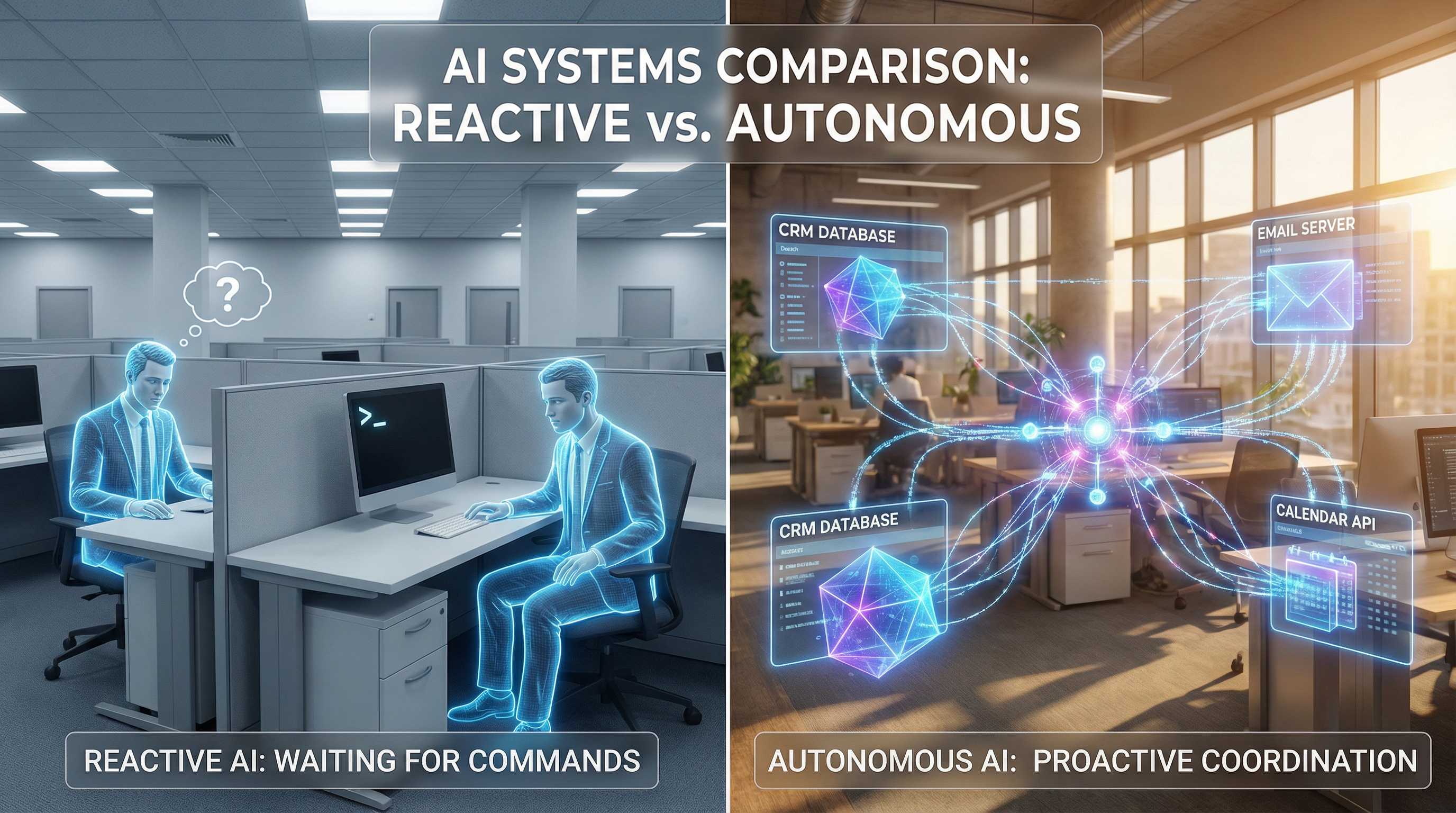
Consider what happens when a prospect downloads your whitepaper at 11 PM on a Saturday. An AI assistant does nothing until Monday when you log in, notice the notification, and craft a follow-up. An orchestrated AI agent immediately enriches the contact data, checks your CRM for any existing relationship history, drafts a personalized follow-up email based on the content they downloaded, stages it for your review (or sends it automatically based on your preferences), schedules a reminder if there's no response in 48 hours, and creates a CRM task with full context.
By Monday morning, you're not starting from scratch. The relationship is already in motion.
This is why Salesforce, OpenAI, and Microsoft are all building multi-agent ecosystems right now. They see what's coming. The question is whether your business will be ready when it arrives—or whether you'll spend the next two years playing catch-up.
Orchestration vs. More Point Solutions: Why Connection Beats Addition
When most businesses hit productivity constraints, they add another tool. Need better email outreach? Add a marketing automation platform. Struggling with follow-up? Add a task management system. Want smarter prospecting? Add a sales intelligence tool.
The average professional now juggles 12+ applications just to do their job. More dashboards. More tabs. More notifications. More things to manage. And still—the most important thing falls through the cracks. Relationships die in the gaps between systems.
AI orchestration takes the opposite approach: instead of adding another platform, it makes your existing systems work together intelligently. Think of it as the relationship intelligence layer that sits between your CRM, email, calendar, messaging apps, and contact enrichment tools—translating intent into coordinated action.
What Orchestration Actually Means for Your Pipeline
Let's get specific. Orchestration means your AI can:
- Detect relationship signals across systems — Notice when a prospect goes quiet after three positive meetings, when a customer's email tone shifts from engaged to frustrated, or when a lead matches your ideal customer profile based on enrichment data
- Stage contextual actions automatically — Draft the follow-up email, schedule the check-in call, create the CRM task, trigger the nurture sequence—all based on relationship context, not just rules
- Preserve institutional knowledge — When your top performer leaves, the next person doesn't inherit a Rolodex. They inherit complete relationship history, communication patterns, and context that makes customers feel continuity, not abandonment
- Prevent revenue leakage — No opportunity dies because someone forgot to follow up, no customer gets ignored because their account manager is overwhelmed, no warm lead goes cold because it fell into a system gap
This isn't about working faster. It's about ensuring that every relationship gets the attention it deserves—and that attention translates to revenue.

The "Plaid for Relationships" Moment is Here
Ten years ago, financial data was locked in bank accounts, fragmented across institutions, nearly impossible for applications to access programmatically. Plaid solved this by building a connectivity layer—an API that unlocked financial data and enabled an entire generation of fintech innovation.
Relationship data is at that same inflection point right now.
Your most valuable business asset—the relationships that drive revenue—is locked across CRMs, email systems, calendars, and messaging platforms. Each system has a piece of the puzzle, but none of them can see the complete picture. The orchestration layer that connects these systems and turns fragmented data into relationship intelligence is the infrastructure play of the agent era.
Just as Plaid became essential infrastructure for fintech, relationship intelligence orchestration will become essential infrastructure for any business where relationships matter. Sales organizations. Brokerages. Financial advisors. Real estate. Wealth management. Consulting. Professional services. High-touch B2B.
The businesses building this capability now—whether through internal development or partnerships with platforms that provide it—will own a structural advantage that compounds over time.
How Riley Demonstrates AI That Acts, Not Just Assists
Theory is interesting. Reality is what matters. Let's talk about what orchestrated relationship intelligence looks like in production.
Riley is an always-on AI sales assistant built on BŪP's Intent-to-Action API—the orchestration layer that connects CRMs, email, calendars, messaging, and contact enrichment into coordinated action. Riley isn't a chatbot you prompt or a tool you manage. It's an autonomous agent that works your pipeline 24/7.
What Riley Actually Does
Riley finds leads that match your ideal customer profile by continuously monitoring multiple data sources. It enriches contacts automatically, pulling in company data, social profiles, recent news, and relationship context from across your systems. It runs personalized outreach sequences that adapt based on engagement, not just predetermined timelines. It handles follow-ups after meetings by analyzing calendar events and drafting contextual next steps. It manages your inbox by triaging messages, surfacing what needs your attention, and handling routine communications autonomously. It keeps your CRM updated without you touching it—because the data flows automatically through the orchestration layer.
Most importantly: Riley does all of this proactively. It watches for opportunities and risks. It acts when timing matters. It alerts you when human judgment is needed.
This is the difference between an AI assistant and an AI agent. Assistants are powerful tools—when you remember to use them. Agents are autonomous systems that ensure nothing falls through the cracks.
BŪP Cards: Where Physical Networking Meets Digital Orchestration
Orchestration isn't just about what happens at your desk. It's about turning every relationship touchpoint—including face-to-face networking—into coordinated action.
BŪP Cards are smart NFC cards where every tap captures a lead and triggers AI-powered follow-up through Riley's orchestration engine. You meet someone at a conference, they tap your card, and immediately: their contact information is captured and enriched with company data and social profiles, Riley drafts a personalized follow-up email referencing your conversation, a CRM record is created with full context including event location and date, and a 72-hour follow-up reminder ensures nothing falls through the cracks.
By the time you're back at your hotel, the relationship is already in motion.
Competitors give you a digital business card—a profile page that sits in someone's phone. BŪP Cards give you a lead capture system connected to an intelligence layer that ensures every handshake becomes a relationship that actually goes somewhere.
This is what orchestration looks like in practice: physical interactions, digital intelligence, and autonomous action working together seamlessly.
The Revenue Protection Argument: Why Orchestration Isn't Optional
Let's talk about money. Not theoretical ROI from vendor case studies—actual revenue protection for relationship-driven businesses.
The Cost of Relationship Gaps
When opportunities die in the gaps between your systems, you lose revenue in ways that are hard to measure but devastating to aggregate:
- The warm lead who went cold because follow-up got buried in email chaos
- The customer who churned because their subtle frustration signals never surfaced to their account manager
- The cross-sell opportunity that never happened because the data showing readiness lived in a different system
- The strategic relationship that went dormant because nobody knew it needed attention until it was too late
Multiply these invisible losses across your entire organization, every single day. For a 50-person sales team, relationship gaps conservatively cost $1.2-2.4 million annually in lost revenue. That's the cost of disconnected systems.
The Value of "No Customer Gets Ignored"
Orchestration delivers value through a simple but powerful principle: every relationship gets the attention it deserves, at the moment it matters most.
When your systems work together intelligently, response time to opportunities drops from hours to minutes, follow-up consistency approaches 100% (not the 30-40% typical in manual systems), relationship context transfers seamlessly when team members change, and revenue leakage from system gaps essentially disappears.
For sales organizations, this typically translates to 15-25% revenue increase in the first year—not from working harder, but from ensuring that existing opportunities don't die in the gaps.
Building vs. Buying Relationship Intelligence Infrastructure
Every forward-thinking business leader is asking the same question right now: should we build our own orchestration layer, or partner with a platform that provides it?
The honest answer depends on your technical capability, strategic priorities, and competitive timeline.
The Build Path
Building internal orchestration infrastructure makes sense if you have experienced engineering talent with API integration and AI expertise, unique relationship workflows that require deep customization, the runway to invest 12-18 months before seeing production value, and strategic commitment to relationship intelligence as core competitive differentiation.
Large enterprises with significant technical resources often choose this path. The advantage is complete control and deep customization. The disadvantage is time-to-value and ongoing maintenance costs.
The Partnership Path
Partnering with an orchestration platform makes sense if you need production value in weeks, not quarters, want to focus internal resources on core business rather than integration plumbing, require proven reliability and security for relationship data, and need flexibility to adapt as agent technology evolves rapidly.
BŪP's Intent-to-Action API provides the orchestration layer that connects CRMs, email, calendars, messaging, and enrichment systems—deployed either as white-glove enterprise infrastructure or through products like Riley and BŪP Cards.
The advantage is immediate deployment with continuous platform improvements. The tradeoff is dependency on external infrastructure—though that's true of your CRM, email system, and virtually every other business-critical platform you already use.
The Real Question
It's not whether you need relationship intelligence orchestration. It's whether you can afford to wait 18 months while building it internally—or whether your market demands you deploy it now and iterate from there.
What to Orchestrate First: Start with Your Highest-Pain Workflow
The biggest mistake businesses make with orchestration is trying to connect everything at once. Start with one workflow that causes the most revenue leakage right now.
High-Impact Starting Points for Sales Teams
- Post-meeting follow-up orchestration: Connect calendar, email, and CRM so every meeting automatically triggers personalized follow-up, CRM updates, and scheduled reminders. For most teams, this alone prevents 40-50% of opportunity leakage.
- Lead enrichment and qualification: Connect lead capture, enrichment services, and CRM so every new contact automatically gets company data, social profiles, ICP scoring, and appropriate routing. This eliminates the lag between "we got a lead" and "we know if it's worth pursuing."
- Pipeline risk detection: Connect CRM, email engagement tracking, and calendar data to surface relationships going cold before they die. When a promising deal has had no meaningful contact in two weeks, automatic staging of re-engagement actions prevents it from slipping away.
Pick one. Deploy it. Measure the impact. Then expand to the next highest-value workflow. Orchestration value compounds as more systems connect, but trying to orchestrate everything on day one is a recipe for delayed implementation and compromised results.
Security, Compliance, and the "How Do We Trust This?" Question
Relationship data is sensitive. Contact information, communication history, deal details, strategic context—this is the data that defines your competitive position. Any orchestration platform touching this data must earn trust through demonstrated security, not marketing promises.
The concerns are legitimate: 59% of executives worry about data leaks from GenAI tools, according to Forrester. The difference between secure orchestration and risky AI hacks comes down to architecture.
What Secure Orchestration Looks Like
- SOC 2 compliance pathways with regular audits and penetration testing
- Data minimization principles where only necessary information crosses system boundaries
- Encryption in transit and at rest, with customer-controlled access policies
- Clear data residency and retention policies that respect regulatory requirements
- API authentication that doesn't create backdoor vulnerabilities in existing systems
BŪP's Intent-to-Action API is built with security as infrastructure, not an afterthought—drawing directly from the financial services security standards our technical team helped establish during their time building banking connectivity layers.
The question isn't whether orchestration introduces security risk. The question is whether the orchestration platform you choose treats security with the same rigor as the financial infrastructure you already trust with your business-critical data.
2026: The Year That Separates the Winners
Every few years, a technology shift creates a competitive divide that's nearly impossible to overcome once it widens. Cloud computing did this in the 2010s. Mobile did it before that. AI orchestration is doing it right now.
The businesses connecting their relationship systems in early 2026 will build advantages that compound daily: better response times lead to higher conversion rates, richer relationship context leads to stronger customer retention, autonomous follow-up systems free up time for strategic selling, institutional knowledge preservation prevents revenue loss during team transitions.
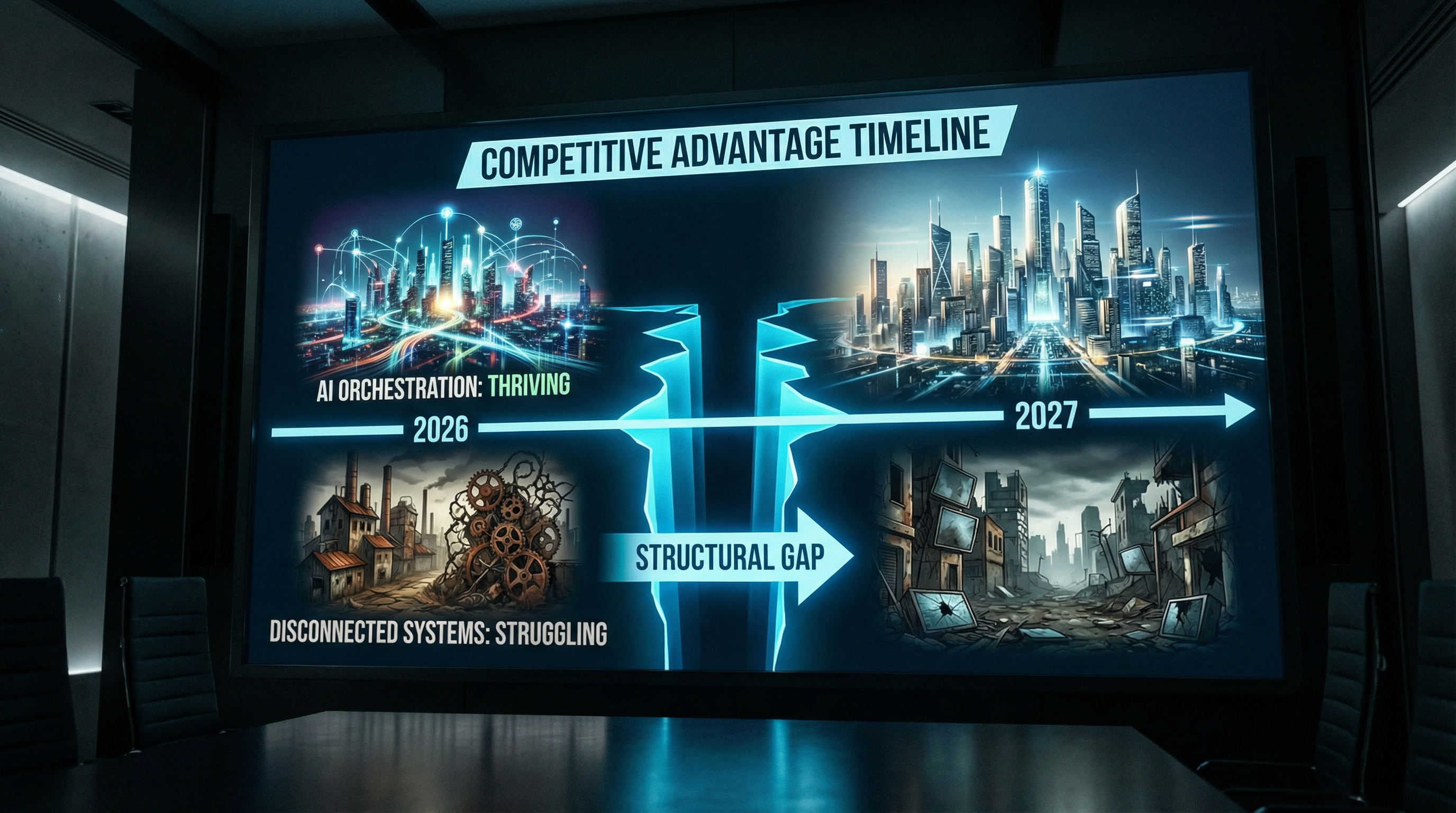
Meanwhile, businesses still duct-taping disconnected tools together will face accelerating disadvantages: talented people leave for organizations with better technology, customers expect the responsiveness that orchestrated competitors deliver, manual processes can't scale fast enough to match AI-augmented growth, and relationship gaps continue bleeding revenue invisibly.
The gap will widen throughout 2026. By 2027, it will be structural. The question is which side of that divide your business will occupy.
What Happens Next
If you're reading this and seeing your business in these scenarios—relationships dying in system gaps, revenue leaking through follow-up failures, institutional knowledge walking out the door with departing employees—you have a decision to make.
You can keep managing disconnected tools manually, hoping your team's discipline and effort will be enough to compete against organizations deploying autonomous agents. Or you can recognize that 2026 is the year the game changes, and position your business accordingly.
Orchestration isn't coming. It's here. The only question is whether you'll deploy it while there's still competitive advantage to capture—or whether you'll implement it in 18 months as a desperate catch-up effort when customers are already choosing competitors with better technology.
The era of AI that assists is ending. The era of AI that acts is beginning. Your relationships are too valuable to leave trapped in disconnected systems.