In 2013, two Stanford graduates had a realization that would transform an entire industry. Banks held incredibly valuable data—transaction histories, account balances, spending patterns—but it was locked behind thousands of different systems with no standardized way to access it. Fintech innovation was strangled by the impossibility of connecting to financial data.
Plaid solved that problem. They built a connectivity layer—a single API that could talk to over 12,000 financial institutions—and unlocked financial data for an entire generation of applications. Venmo, Robinhood, Coinbase, and thousands of other fintech companies exist because Plaid made the impossible possible.
In 2026, we're standing at an identical inflection point. But this time, it's not financial data that's locked away. It's relationship intelligence.

The Relationship Data Problem: Déjà Vu All Over Again
Your business runs on relationships. Every sale starts with a connection. Every partnership begins with a conversation. Every customer success story is built on trust developed over dozens of interactions.
Yet the data that captures those relationships—the emails, the calendar appointments, the CRM notes, the LinkedIn messages, the Slack conversations, the Zoom transcripts—lives in completely disconnected systems that don't talk to each other.
Sound familiar? It should. This is exactly the problem Plaid solved for financial data.

The consequences are expensive:
- Your sales team meets a hot prospect at a conference. Two weeks later, the contact is still sitting in a pile of business cards because nobody had time to enter it into the CRM.
- Your top account executive leaves for a competitor. Three decades of relationship knowledge—who knows whom, which customers prefer phone calls over email, which prospects are ready to buy—walks out the door with them.
- Your CRM shows that a key customer hasn't heard from anyone in 90 days. But that's not true—your CEO emailed them last month. The CRM just doesn't know about it because the systems don't sync.
- You have buying signals scattered across five different platforms. Your marketing automation tool sees website visits. Your CRM tracks email opens. Your sales team has calendar notes. Your support system logs product usage. Nobody has the complete picture.
Industry research shows this fragmentation isn't just annoying—it's costing businesses real money. When vital information is scattered across disconnected tools, sales teams turn to spreadsheets for personal tracking, opportunities fall through the cracks, and relationship-driven revenue suffers.
The Spreadsheet Symptom: When Infrastructure Fails
Here's a diagnostic question: Do your relationship-focused teams—sales, customer success, business development—maintain their own spreadsheets outside your official systems?
If the answer is yes, you don't have a people problem. You have an infrastructure problem.
Spreadsheets are what professionals resort to when enterprise systems fail to give them a unified view of what matters. When your CRM doesn't reflect the conversation from yesterday's email, when your task management tool doesn't know about tomorrow's calendar appointments, when no single system can answer "which relationships need my attention right now?"—smart people build workarounds.
Those workarounds are symptoms of a deeper issue: relationship intelligence lacks the infrastructure layer financial data received over a decade ago.
What Plaid Taught Us About Infrastructure Layers
Before we explore the solution, let's understand what made Plaid transformative. It wasn't the technology alone—APIs existed before Plaid. It was the business model: building infrastructure that everyone could use rather than point solutions that only solved one company's problem.
Plaid recognized several key insights:
1. The Value Is in the Connectivity, Not the Data Itself
Banks already had customer financial data. Fintech apps already knew what they wanted to do with that data. The gap was access. Plaid didn't try to become a bank or a fintech app—they built the layer that connected them.
2. Standardization Unlocks Innovation
Before Plaid, every fintech startup had to build custom integrations with every bank they wanted to support. It was technically possible but economically prohibitive. Plaid created a standard interface—connect once to Plaid, access 12,000+ institutions—that made previously impossible business models suddenly viable.
3. Security and Compliance Must Be Built In, Not Bolted On
Financial data is sensitive. Plaid achieved SOC 2 compliance, ISO 27001 certification, and built encrypted infrastructure that financial institutions could trust. Security wasn't an afterthought—it was the foundation.
4. Scale Requires Infrastructure, Not Duct Tape
Individual companies can connect a few systems with Zapier workflows and manual processes. But you can't build an industry on duct tape. Plaid created API-first infrastructure designed for scale, reliability, and developer experience.
These lessons apply directly to the relationship intelligence challenge businesses face today.
Relationship Intelligence: The Connectivity Layer That Doesn't Exist (Yet)
Here's what a "Plaid for relationships" infrastructure would look like:
Unified Access to Relationship Data Across Systems
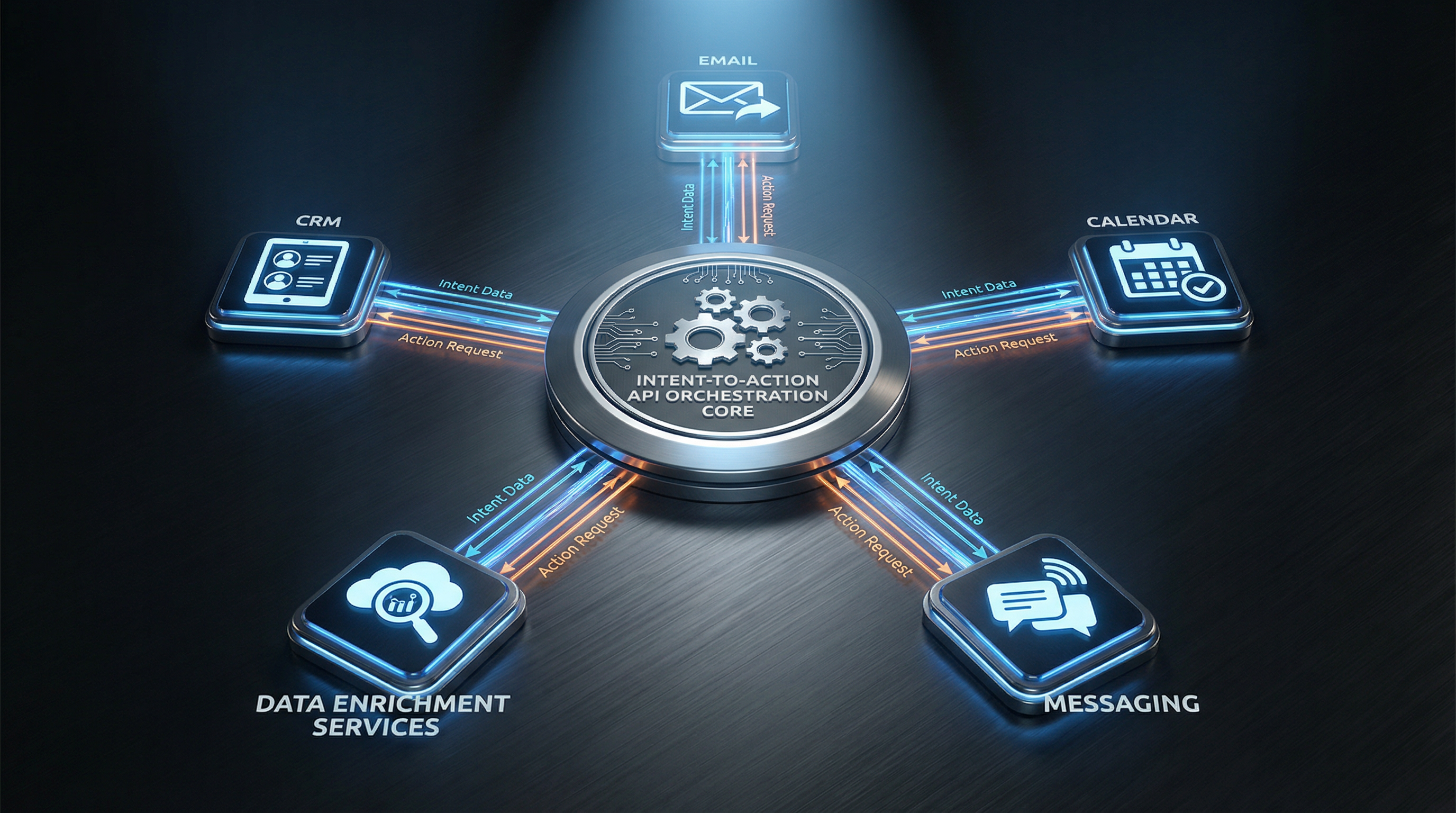
Just as Plaid connects to thousands of banks through a single API, relationship intelligence infrastructure connects to your CRM, email platform, calendar, messaging tools, contact enrichment services, and any other system where relationship data lives. One integration point unlocks access to the complete relationship context.
Intent-to-Action Orchestration
Financial data infrastructure like Plaid is largely about access—retrieving account balances and transaction histories. Relationship intelligence requires something more sophisticated: orchestration. It's not enough to know that a prospect opened your email three times. The system needs to act on that signal—adjust the follow-up timing, alert the sales rep, update the CRM with engagement data.
This is the evolution from data access to intelligent action. Industry research shows the progression goes: Revenue Operations (connecting tools) → Revenue Intelligence (surfacing insights) → Revenue Orchestration (coordinating action across systems).
Multi-System Context and Memory
One of the most valuable but overlooked capabilities: an orchestration layer provides memory across systems. When your account executive leaves, the relationship context doesn't leave with them. When a customer emails your CEO directly instead of going through support channels, the interaction gets captured and made available to everyone who needs it.
This is institutional memory as infrastructure, not as tribal knowledge trapped in individuals' heads.
Built for AI Agents, Not Just Human Users
This is where relationship intelligence infrastructure diverges from Plaid's model. Plaid primarily serves applications that present data to human users. Relationship intelligence infrastructure must serve autonomous AI agents that take action without human intervention.
That changes the requirements. Agents need:
- Real-time access to relationship context across all systems
- The ability to execute actions (send emails, update CRM, schedule calendar appointments) across multiple platforms
- Continuous monitoring for signals that trigger workflows
- Decision-making frameworks that balance autonomy with appropriate human oversight
You can't build autonomous AI agents on duct-taped systems. You need purpose-built orchestration infrastructure.
Why 2026? Three Forces Converging
Infrastructure moments don't happen randomly. They emerge when multiple enabling forces converge. For Plaid, it was the combination of API technology maturity, smartphone adoption, and demand for digital financial services. For relationship intelligence, three forces are converging in 2026:
1. AI Agents Are Ready for Production
As we explored in detail in our article on AI agents vs. AI assistants, 2026 is the year AI agents go from pilots to widespread deployment. According to Gartner, 40% of enterprise applications will feature task-specific AI agents by the end of 2026, up from less than 5% in 2025.
But agents can't operate effectively on disconnected systems. The demand for AI agent deployment is creating urgent demand for orchestration infrastructure.
2. The Integration Tax Has Become Unsustainable
Industry research shows that 44% of worker productivity is lost to fragmented systems. That's not a rounding error—that's nearly half of every employee's working hours consumed by the friction of disconnected tools.
The early 2010s approach of "just add another integration" has hit a wall. The average enterprise now uses 12+ systems for relationship management alone. Point-to-point integrations scale at O(n²)—connecting 12 systems requires 66 individual integrations. That's not sustainable.
Companies are ready to invest in infrastructure that solves the root problem rather than continuing to add integration Band-Aids.
3. Competitive Pressure Is Forcing Action
The companies that have already deployed relationship intelligence infrastructure are seeing 30-50% efficiency gains in sales, customer success, and business development. Those aren't marginal improvements—they're competitive game-changers.
Recent surveys found that 93% of business leaders believe organizations successfully scaling AI in the next 12 months will gain an edge over industry peers. That belief is driving infrastructure investment.
What Relationship Intelligence Infrastructure Actually Does
Here's what happens when you deploy real relationship intelligence infrastructure:
Scenario 1: The Conference Lead That Doesn't Die
Before: Your business development team attends an industry conference. They collect 50 business cards. Three weeks later, 12 have been entered into the CRM. The other 38 are sitting on someone's desk with a mental note to "follow up soon."
With Relationship Intelligence Infrastructure:
- Every contact is captured immediately via smart NFC cards or mobile app
- The orchestration layer automatically enriches each contact with company data, role information, and recent news
- Contacts are analyzed against your ideal customer profile and prioritized
- Personalized outreach sequences launch within 24 hours, with messaging tailored to each prospect's industry and role
- The AI agent monitors responses, identifies engagement signals, and adjusts follow-up cadences accordingly
- High-priority prospects showing genuine interest are surfaced to your sales team with full context
- All activity syncs across CRM, email, and task management systems automatically
The result: Zero leads fall through the cracks. Your team focuses only on prospects showing real interest. Relationship context is preserved forever, not lost in desk clutter.
Scenario 2: The Customer at Risk (That You Actually Save)
Before: Your best customer hasn't logged into your product in three weeks. Support tickets are up 40%. Their executive sponsor changed jobs two months ago, but your account manager didn't know until the renewal conversation went sideways. You lose a $250K annual contract.
With Relationship Intelligence Infrastructure:
- The orchestration layer monitors product usage, support ticket patterns, email engagement, and calendar activity across all touchpoints
- When usage drops and support tickets spike, the system recognizes the pattern as an at-risk signal
- LinkedIn integration catches the executive sponsor's job change in real-time
- The AI agent automatically surfaces the account to the customer success team with full context and recommended actions
- A proactive outreach sequence initiates: check-in email, offer of training resources, executive business review proposed
- Calendar integration identifies mutual availability and proposes meeting times
- The customer success manager gets a notification: "Customer X showing risk signals—recommended actions staged and ready to execute"
The result: Problems are caught and addressed before they become crises. Customer success teams operate proactively, not reactively. Renewals are protected.
Scenario 3: The Cross-Sell Opportunity You Actually Close
Before: Your core banking system shows a small business customer's deposits have tripled in six months. They're clearly growing fast and probably need a larger line of credit. But that data lives in one system. Your commercial banker works in the CRM. The signal never connects to action. Your competitor calls them first.
With Relationship Intelligence Infrastructure:
- Banking transaction data flows through the orchestration layer in real-time
- The intent engine recognizes deposit growth as a buying signal for credit products
- Cross-system context shows the customer also recently hired (LinkedIn posts), expanded to new offices (public records integration), and landed a major contract (news monitoring)
- The AI agent generates a personalized outreach: "Congratulations on your growth—let's discuss how our commercial lending can support your expansion"
- The commercial banker gets a notification with full context, recommended talking points, and a draft email ready to send
- Calendar integration identifies the customer's availability and proposes meeting times
- CRM automatically updates with all activity and sets follow-up reminders
The result: You close the cross-sell before competitors even know the opportunity exists. Revenue per customer increases. Retention strengthens because you're proactively supporting growth.
The Security and Compliance Imperative
Just as Plaid couldn't have succeeded without earning the trust of financial institutions, relationship intelligence infrastructure must be secure by design.
This means:
- SOC 2 compliance and ISO 27001 certification: Enterprise-grade security that passes institutional scrutiny
- Data governance frameworks: Clear policies on what data is accessed, how it's used, and who controls it
- Encrypted infrastructure: Data in transit and at rest protected to banking-grade standards
- Audit trails: Complete visibility into what actions AI agents take and why
- Privacy controls: GDPR, CCPA, and industry-specific compliance built in
According to Multimodal.dev's AI agent research, 59% of executives worry about data leaks from GenAI tools. Relationship intelligence infrastructure must address those concerns from day one, not as afterthoughts.
This is why risky GenAI hacks—connecting ChatGPT to your CRM via screen scraping or credential sharing—won't scale. Enterprises demand secure, domain-specific AI infrastructure with proper access controls and compliance frameworks.
Build vs. Buy: The Infrastructure Decision
Every enterprise faces this question: Should we build relationship intelligence infrastructure internally, or adopt a platform built for this purpose?
Consider what building it yourself requires:
- API integrations with every system where relationship data lives (CRM, email, calendar, messaging, enrichment services, etc.)
- Ongoing maintenance as those systems release API changes
- Data normalization across systems with different schemas and formats
- Real-time synchronization infrastructure
- Intent recognition and signal processing engines
- Orchestration logic for coordinating actions across systems
- Security, compliance, and audit frameworks
- AI agent development and management capabilities
Some large enterprises with significant engineering resources will choose to build. For most organizations, relationship intelligence infrastructure is too important to be a side project—but not core enough to justify dedicated teams.
This is the same calculation fintech startups made with Plaid. Technically, every company could build bank integrations themselves. Practically, using infrastructure purpose-built for the problem lets them focus on their core differentiation.
From Point Solutions to Platform Thinking
The shift to infrastructure thinking requires a mental model change. For the past decade, businesses approached every problem by adding another tool:
- Need better email outreach? Add a sales engagement platform.
- Want to track customer health? Add a customer success tool.
- Need data enrichment? Add a prospecting database.
- Want to automate follow-ups? Add a marketing automation platform.
Each tool solved a specific problem. But collectively, they created a bigger problem: disconnection. According to Shopify's research on CRM integration, the average business now juggles 12+ applications just for relationship management.
Platform thinking flips the equation. Instead of asking "what tool solves this specific problem?", ask "what infrastructure makes our existing tools work together intelligently?"
This shift is happening across enterprise software:
- Plaid for financial data: Connect once, access thousands of institutions
- Stripe for payments: One API, global payment infrastructure
- Twilio for communications: Unified interface for SMS, voice, video, messaging
- Segment for customer data: Single pipeline for collecting and routing analytics events
Each represents the same pattern: infrastructure that connects existing systems and enables capabilities that weren't possible with disconnected tools.
Relationship intelligence is next.
What Changes When Infrastructure Exists
The real impact of infrastructure layers becomes visible not in the infrastructure itself, but in what becomes possible once it exists.
Before Plaid, building a consumer banking app required years of integration work before you could even start on product differentiation. After Plaid, you could launch a fintech product in months. The infrastructure enabled an entire generation of innovation.
The same pattern will play out with relationship intelligence:
AI Agents Become Practical, Not Theoretical
Today, companies pilot AI agents in narrow, controlled environments because orchestrating action across disconnected systems is prohibitively complex. With proper infrastructure, agents can operate across your entire relationship stack—finding opportunities, executing outreach, managing follow-ups, updating systems, and alerting humans when needed.
Institutional Memory Becomes Permanent
The knowledge that currently walks out the door when employees leave—who knows whom, which relationships are warm, what customers prefer, where opportunities exist—becomes preserved in the infrastructure layer. Relationship context survives turnover.
Relationship-Driven Revenue Becomes Scalable
High-touch, relationship-focused business models currently hit scaling walls. You can only hire so many account executives, customer success managers, and business development reps. With infrastructure that orchestrates relationship intelligence, you can scale relationship-driven revenue without proportionally scaling headcount.
Opportunities Stop Dying in System Gaps
The most expensive problem in relationship-driven businesses isn't the deals you lose to competitors—it's the opportunities that die because nobody knew they existed. A warm introduction that could have been made. A renewal risk that wasn't caught. A cross-sell signal that never reached the right person. Infrastructure closes those gaps.
The Competitive Landscape: Who's Building This?
The race to become "the Plaid of relationship intelligence" is underway. Several categories of companies are approaching the opportunity:
CRM Vendors Adding AI
Salesforce AgentForce, Dynamics 365 AI capabilities, and other CRM platforms are building AI features. But they face a structural challenge: CRMs are one system in the relationship data stack. True orchestration requires connecting across systems, not just making one system smarter.
Integration Platforms Expanding Capabilities
Zapier, Make, and other integration platforms enable connecting systems. But they're designed for human-triggered workflows, not autonomous AI agent orchestration. They're duct tape, not infrastructure.
Purpose-Built Relationship Intelligence Platforms
Companies building specifically for this problem—intent-to-action APIs, relationship orchestration layers, AI-native infrastructure—represent the most direct path to solving it. They start with the orchestration challenge rather than retrofitting existing products.
The winner won't be determined by who has the best AI models (those are increasingly commoditized) or the most integrations (necessary but insufficient). It will be determined by who builds infrastructure that enterprises trust, developers love using, and AI agents require to operate effectively.
What Forward-Thinking Businesses Are Doing Now
If you believe relationship intelligence infrastructure is coming—and the market indicators suggest it's not just coming, it's here—what should you do?
1. Audit Your Relationship Data Stack
Map where relationship data lives in your organization. CRM, email, calendar, messaging platforms, support systems, marketing automation, data enrichment tools—list them all. Then identify the gaps: What data isn't captured? What systems don't talk to each other? Where do opportunities fall through the cracks?
2. Calculate Your Integration Tax
How much time do your relationship-focused teams (sales, customer success, business development) spend on administrative work instead of relationship building? What percentage of opportunities do you estimate you miss because systems don't communicate? What does employee turnover cost you in lost relationship context?
Put dollar figures on those costs. That's your business case for infrastructure investment.
3. Start With High-Value Use Cases
You don't need to orchestrate everything on day one. Identify the highest-value relationship workflow where disconnection is costing you money. Often it's sales follow-up, customer retention, or cross-sell opportunity recognition. Prove the model there before scaling.
4. Evaluate Infrastructure Platforms
Look for platforms that offer:
- Pre-built integrations with your critical systems
- Intent recognition and signal processing capabilities
- Orchestration logic for coordinating multi-system actions
- Support for autonomous AI agents, not just human workflows
- Enterprise-grade security and compliance
- Developer-friendly APIs if you need customization
5. Prepare Your Team for the Shift
Infrastructure investments succeed or fail based on adoption. Help your team understand that relationship intelligence infrastructure isn't about replacing them—it's about freeing them from administrative busywork so they can focus on high-value relationship building and strategic work.
The Plaid Analogy's Limitations (And Why They Matter)
Before we conclude, it's worth examining where the Plaid analogy breaks down—because those differences matter:
Financial Data Is (Relatively) Standardized
Bank accounts, transactions, and balances have well-defined structures. Relationship data is messier—unstructured email conversations, meeting notes in various formats, inconsistent CRM hygiene. Relationship intelligence infrastructure requires more sophisticated normalization.
Financial Institutions Are Regulated Uniformly
Banks operate under consistent regulatory frameworks that facilitate standardized integration approaches. Relationship data spans industries with different compliance requirements—healthcare has HIPAA, finance has FINRA, Europe has GDPR.
Financial Data Access Is Largely Read-Only
Plaid primarily retrieves data—checking account balances, reading transaction histories. Relationship intelligence requires bidirectional orchestration—reading signals AND executing actions across systems.
Relationship Context Requires Multi-System Intelligence
You can get useful value from connecting to a single bank via Plaid. Relationship intelligence only becomes truly valuable when you connect across multiple systems simultaneously. The value is in the synthesis, not individual data sources.
These differences don't invalidate the analogy—they highlight why relationship intelligence infrastructure is actually harder than what Plaid accomplished. Which is why 2026 feels late, not early. The technology, market demand, and competitive pressure have finally reached the point where solving this problem is both possible and urgent.
The Infrastructure Era for Business Relationships
We're entering the infrastructure era for business relationships. Just as the 2010s saw infrastructure layers emerge for financial data, payments, communications, and customer analytics, the 2020s will be defined by infrastructure for relationship intelligence.
The companies that recognize this shift and build on proper infrastructure—rather than continuing to duct-tape disconnected systems—will have the competitive advantage in the agent era.
Because here's the fundamental truth: AI agents that act autonomously across your relationship stack require infrastructure that enables them to do so. You can't build the future on yesterday's disconnected systems.